Machine Matzos: Timing is Everything!

Reviewed January 2025


Meticulous, scrupulous and passionate are terms that describe the fervor, zeal and seriousness displayed by the kosher consumer regarding Pesach kashrus in general, and Pesach matzos in particular.  The kosher consumer has become more sophisticated and savvy with each passing year. Kosher consumers are willing to pay top dollar for a quality kosher product. Pesach matzos are no exception. Machine matzos with fine Mehadrin hechsheirim are readily available on the supermarket shelf.  Are all machine matzos created equal?

Regarding matzah baking and the time parameters for chimutz (leavening), the Shulchan Aruch states,1 “One should not leave the dough dormant, not for a moment.” If the dough is constantly being worked the chimutz process is impeded. However, the Shulchan Aruch continues, “If the dough is left dormant for a mil, […]

The Rise of Oat Matzos

January 2025

Download PDF of Full Article Here

The advent of baking oat matzah for Pesach is a relatively new phenomenon. As one of the Five Grains, oats qualify as an ingredient for matzah. Until circa 5740 (1980s), however, it never appeared in recorded halacha as something that was done in actual practice.

If someone with a wheat allergy can tolerate spelt, matzah made from spelt is an ideal alternative. Spelt and wheat are closely related both structurally and halachically. Additionally, some suggest that the order of grains in the Mishnah has significance. Thus, spelt, which appears third in the list, takes precedence over rye or oats. Others reject this notion and hold that position on the list does not indicate hierarchy for matzah.

What are the options for people who suffer from celiac disease, an inherited autoimmune disorder identified in the 1950s as being triggered by gliadin […]

The Traveler’s Halachic Guide to Hotels

Spring 2010 | Updated December 2025

Yosef chose the hotel he was staying in for its many amenities, not the least of which was the free Continental Breakfast it offered its guests. Surely, when kosher symbols on products are becoming more and more prevalent, he wouldn’t starve! The breakfast menu included cereals, pancakes, waffles, muffins, pre-cut fruits and vegetables, hardboiled eggs, as well as hot coffee and juices. Can Yosef eat anything offered on the Continental Breakfast menu, or should he prepare his own breakfast using the microwave and coffeemaker in his hotel room?

Chana’s brother’s bar mitzvah, held in a hotel during Shabbos, turned out to be a real nightmare! The closet light went on automatically when she opened the closet door; the housekeeper had turned off the light in her room, preventing her from reviewing her parsha notes; she drank a bottle of water from her room’s ‘refreshment bar’ which […]

Navigating the Ins and Outs of Renting an Airbnb

Winter 2024 | Reviewed January 2026

Who would have imagined, just a few years ago, that you could go on vacation and rent a stranger’s private home? But that is exactly what people now do every day, with the rise of Airbnb and similar short-term rental platforms that list millions of units in over 100,000 cities.[1]

A Torah-observant individual who enters into such an arrangement will encounter numerous halachic challenges when signing up as an Airbnb “guest.” This includes properties listed as “kosher” – even ones in Israel – since an owner usually cannot vouch for every renter who has used the kitchen, nor for each renter’s kashrus standards, which can vary widely. Likewise, one who owns and is the “host” of an Airbnb property will have to address his own set of halachic concerns. Let’s analyze some of the more common ones.

Kashrus Concerns During the Year (Excluding Pesach)

The primary […]

Going Away for Pesach? Guidelines for Hotel and Airbnb Guests

Reviewed January 2026

Many people leave home to celebrate Pesach with extended family. If that entails staying in a hotel or an Airbnb, there are specific halachos to keep in mind. See below for a brief summary of these halachos.

Kashering Guidelines

A hotel kitchenette or Airbnb requires the same method of kashering for Passover as a home kitchen. One should secure permission from the hotel or Airbnb owner before kashering.

Ideally, all kashering should be completed before the end time for eating chometz on Erev Pesach.1

Sometimes, one might not arrive until later on the day of Erev Pesach, or on Chol HaMoed. If that is the case, then:

If one arrives on Erev Pesach after the end time for eating chometz where the property is located: the oven and stovetop grates may still be kashered. A sink may be kashered if one can ascertain that the sink is aino ben yomo (i.e., […]

Using an Oven on Shabbos and Yom Tov

Reviewed March 2024

To download and print a handy summary of these halachos, click here.

Cooking in the modern kitchen is a whole new experience. Technological advances have taken the old stovetop and oven and upgraded them to be safer, more efficient, and “smart” for today’s lifestyle. They are also far more complicated. With these transformations, the observant Jew is faced with challenges that did not confront him in the past.

To understand how these changes affect the halachic use of ovens and cooktops on Shabbos and Yom Tov, it is worthwhile to review some laws and concepts as they relate to cooking on Shabbos and Yom Tov.

A. Terms and Prohibitions Pertaining to Food Preparation on Shabbos and Yom Tov

Definitions of Basic Terms

Melacha A melacha is a Torah prohibited act derived from the constructive acts performed in erecting the Mishkan . These forbidden acts are known […]

STAR-K Appliance-Related Articles & Videos

The STAR-K site offers a variety of informative articles and videos related to the general use of cooking and refrigeration appliances; various Sabbath Mode features in STAR-K certified models; the halachic implications of using them on Shabbos and Yom Tov; appliance pre-purchase advice; as well as articles about other Sabbath Mode technologies, such as medical devices and elevators.

CHART

STAR-K Guide to Using Ovens on Shabbos & Yom Tov (PDF)

ARTICLES ABOUT COOKING APPLIANCES

Article on Oven Use (Published in Yeshurun, Vol. 36) – HaRav Moshe Heinemann shlit”a

Teshuva on Oven Use on Yom Tov – HaRav Moshe Heinemann shlit”a

Using an Oven on Shabbos & Yom Tov – Rabbi Avrohom D. Mushell (March 2024)

Handling With Care: Boneh in the Kitchen – Rabbi Chananya Jacobson (Spring 2026)

Oven Kashrus 101: Using the Same Oven for Meat, Dairy, Fish and Pareve – Rabbi Dovid Heber (Spring 2016)

Oven Kashrus: For Shabbos Use […]

What To Do If Chometz is Found During Pesach

Reviewed January 2026

Erev Pesach (after the time of Biur Chometz)

If you find chometz on Erev Pesach after the latest time for biur chometz:

If you sold your chometz earlier that morning: You should move the chometz that you found to the place that you are storing the chometz that you sold.
If you did not sell your chometz earlier that morning: You should burn it.

First Day of Pesach

If you find chometz on the first day of Pesach: You should cover it with a utensil.

See below for further instructions for the subsequent days of Pesach.

Second Day of Pesach

If you find chometz on the second day of Pesach, or if you found chometz on the first day of Pesach and had covered it:

If you sold your chometz before Pesach, or you said ‘Kol Chamira’ before Pesach, or the chometz that you found was less than a kezayis: You should cover it with a utensil […]

Guide to Buying Chometz After Pesach

Updated February 2026

Download PDF of Chometz She’avar Alav HaPesach Product List Here

From a Jewish-Owned Store That Did Not Sell Its Chometz to a Non-Jew Before Pesach

The Torah forbids a Jew to own chometz on Pesach. In order to dissuade people from owning chometz on Pesach, there is a rabbinic injunction not to eat or benefit from chometz which was owned by a Jew during Pesach. Such chometz is known as chometz she’avar alav haPesach, and it remains forbidden permanently.1

For this reason, one should not buy chometz from a Jewish-owned store immediately after Pesach, unless the owner sold all chometz that he owned before Pesach to a non-Jew for the duration of Pesach and did not acquire any further chometz during Pesach. The laws of mechiras chometz (selling chometz to a non-Jew for Pesach) are complex; therefore, the sale must be made by a […]

Navigating the Challenges: Shemita 5782

Fall 2021

For over nineteen hundred years, the Jewish people have longed to return to Eretz Yisroel. It is only in Eretz Yisroel that we can realize our full potential as a nation. It is only in Eretz Yisroel that the Torah’s blueprint for life can be completely fulfilled.

For the
millennia, the most important dimension of this longing was the yearning to
once again be able to fulfill the mitzvos hatluyos ba’aretz (agricultural
laws), the commandments that can be observed only in Eretz Yisroel. With Hashem’s
help, many of us in this past generation have realized part of this two
thousand year old dream. Yet, this realization has presented us with new
challenges.

Without a
doubt, one of the greatest mitzvah challenges of all times is the fulfillment
of the mitzvah of Shemita, the year of Sabbatical rest for the Land of
Israel. The Midrash perceives this multifaceted commandment as being so
challenging and difficult that he who meets the challenge […]

Kosher Consumer Misconsumptions

Fall 2021

STAR-K’s
consumer Kosher Hotline is constantly abuzz with kashrus inquiries. Close to
5000 consumer calls were logged between Purim and Pesach 5781 alone. Questions
range from product information to complex kitchen shailos, from reliable
kosher airline caterers to wines whose kosher certification symbols are so
small you need a high-powered magnifying glass to read the rav hamachshir’s
name.

Even
with all the available information, consumers still get confused or make incorrect
assumptions that could lead to severe halachic consequences. The following
examples of kosher consumer misconceptions are based on real Kosher Hotline
inquiries. Hopefully, this article will help clarify some common errors.

Misconception 1: Putting an oven into Sabbath Mode allows
one to cook on Shabbos.

Chas v’shalom! The Sabbath Mode does not allow one to cook on Shabbos. The
Sabbath Mode makes a modern oven halachically compliant so that it may be used on
Shabbos and Yom Tov. The purpose of the Sabbath Mode was to address new
technological and computerized features that have created […]

Optical Allusions: Avoiding Maris Ayin

Fall 2021

Making a Good Impression

The kohen tasked with removing funds from the treasury of
the Bais Hamikdash needed to go to great lengths to avoid any suspicion of
stealing: he could not wear hemmed clothing, or even tefillin, lest he hide a
coin in them. He was required to speak the entire time so that he could not hide
any coins in his mouth. When he exited the treasury, his hair was combed to
ensure that he did not squirrel away any money in his curls! The Mishnah
explains that these measures were necessary, as there is a Torah obligation to
avoid suspicion: “…v’hiyisem neki’im meHashem u’meYisroel, … and you
shall be innocent before Hashem and before Israel.”[1]

Activities that give an impression of transgressing Halacha must
be avoided, even if they are intrinsically permitted. This area of Halacha is
known as maris ayin and chashad, the appearance of transgressing
an issur.[2]
Interestingly, Rav Moshe Feinstein, zt”l, writes that this only […]

The Kosher Conversation Sukkos Special

Arba Minim with Rabbi Mordechai Frankel

A special episode focusing on the Halachos of the Arba Minim: Esrog, Lulav, Hadassim, and Aravos.

Rabbi Frankel walks us through the selection process of the Daled Minim:

Do the size and shape of your esrog matter?Does your lulav need to be straight?How much should you spend on a chinuch set?Do you need to check the esrog with a loupe?

All this and much much more on this special Sukkos episode of the kosher conversation!

Feedback and questions are always welcome at 1-410-816-9509 or [email protected].

A Shemita Primer for Chutz La’aretz

Updated September 11, 2023

By: STAR-K Rabbinic Staff

Beginning on Rosh Hashana this year (5782) and ending Rosh Hashana next year (5783), it is the Shemita/Sabbatical year in Eretz Yisroel. This is certainly one of the most special mitzvos that we have. The amazing demonstration of our absolute faith and emunah in Hashem which is displayed from its proper observance is unique from all other mitzvos. Furthermore, the guarantee that Hashem will provide us with sustenance in advance that comes along with observing Shemita is something that proves that the Torah can be directly only from Hashem himself.

Although Shemita does not apply to land outside of Eretz Yisroel, there are still a number of circumstances that we in chutz la’aretz will likely encounter, and thereby give us the ability to observe the mitzvah of Shemita properly. The laws of Shemita are quite extensive and complex. The goal of this […]

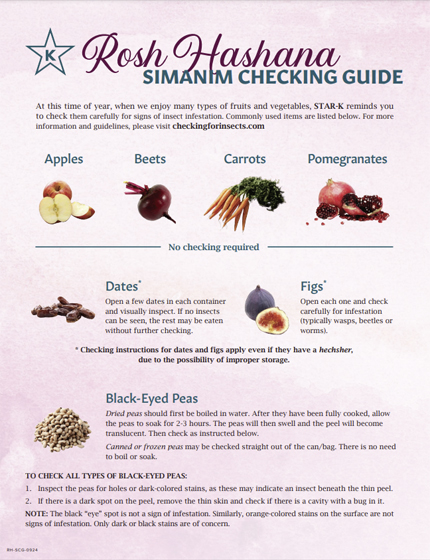
Rosh Hashana Simanim Checking Guide

Click image below for a larger view and a handy printable version.

A HALACHIC GUIDE TO HONEY AND BEE DERIVATIVES

Click here for STAR-K’s Halachic Guide to Honey and Bee Derivates by Rabbi Dovid Heber.

The Kosher Conversation Episode 16: Out of Town Kashrus

Out of Town Kashrus with Rabbi Nosson Dubin of Houston Kosher

In today’s episode Rabbi Nosson Dubin shares with us what it is like to “do kashrus” in an out-of-town community. 

We talk about a wide array of topics, including:

The challenges of kosher supervision in a place where everyone knows you personally.The mandate of ensuring that kosher food is available to local consumers.How one small conversation changed the entire paradigm of kosher supervision.The Kosher Institute of America’s mashgiach training program.What it’s like to participate in the AKO Executive Committee.

and, of course: 

How to run a Kosher Chili Cookoff!

Feedback and questions are always welcome at 1-410-816-9509 or [email protected].

STAR-K Certification Hosts Diverse Klei Kodesh at Annual Food Service and Kashrus Training Programs

Rabbi Yonah Gross eagerly signed up for STAR-K Kosher Certification’s annual Food Service Kashrus Training Seminar held in the agency’s Baltimore offices July 6-8. As the newly appointed Kashrus Administrator of the Community Kashrus of Greater Philadelphia (Keystone-K) – for which he was an active rabbinical board member for seven years – the former Rav of Congregation Beth Hamedrosh in Wynnewood, PA, wanted to learn more about the challenges a mashgiach faces.

Shares Rabbi Gross, “As Kashrus Administrator, I spend plenty of time in our various establishments, but it was very helpful to see things from the perspective of someone who is in our kitchens, catering halls, and factories on an ongoing basis. It is also helpful to learn the best practices of other organizations in order to try to incorporate them into my own organization to strengthen Kashrus in Philadelphia. Interacting with the STAR-K staff is very helpful in developing relationships with […]

Delivery and Ride Apps – Halachically App-roved?

Kashrus Kurrents Summer 2021 | Updated April 2026

With the advent of the latest apps, a whole new world of halachic scenarios has arisen.[1] These include shailos about using food delivery services, working for a food delivery or ride app, and even calling and using a ride service. These various situations will be addressed here.[2]

Ordering from Meal Delivery Apps

Meal delivery apps like Uber Eats,
Grubhub, DoorDash and Postmates have seen tremendous growth over the last few
years. For our discussion, we will use Uber Eats as our example, but the concerns
raised apply to the comparable apps.

A customer orders from a restaurant that has contracted with Uber Eats. When it is ready, an Uber Eats driver picks it up from the restaurant and delivers it to the customer. Here are some points to consider when ordering from a kosher restaurant:

Is the food properly sealed?

Delivered food must be properly sealed.[3]  Many […]

A Traveler’s Guide to Tefilas Haderech

Summer 2021

During the past year and a half, STAR-K mashgichim continued to conduct inspections in the United States and abroad in a manner deemed safe for them and factory personnel. STAR-K is very thankful for their tremendous mesiras nefesh to ensure that our certified products maintained the highest level of kashrus, even in the midst of a worldwide pandemic. Still, many consumers who frequently travel stayed home. With great siyata d’Shmaya, an effective vaccine was developed that has allowed us to resume our busy travel schedules and to once again recite Tefilas Haderech on a regular basis. Let us examine the halachos of this beautiful tefilla.[1]

The Tefilla

Tefilas Haderech is based on the Gemara in Brachos (29b-30a), with some minor variations, depending upon one’s nusach.  The Gemara says it is recited in loshon rabim (plural; e.g., shetolicheinu, etc.).[2]  When returning the same the day, the words v’sachzireinu l’shalom […]

The Kosher Conversation Episode 15: Lab-Grown Meat

Lab-Grown Meat

In this episode we explore the halachic ramifications of cultured meat, (also known as lab-grown or synthetic meat). Rabbi Daniel Friedman shares his pioneering work with us, and Rabbi Joel Kenigsberg keeps us abreast of the latest developments in the field.

Learn how synthetic meat is made! What is it? Can it be Kosher? Can it Be Parve?

Also, a rare recording of Rav Moshe Heinemann. shlita, addressing these issues.

Leave your feedback for the Kosher Conversation at 410-816-9509!

The Kosher Conversation Episode 13: Nikkur and Melicha

Nikkur and Melicha With Rabbi Mayer Kurcfeld

In this episode we go in depth about the steps taken to prepare kosher meat for consumption – nikkur and melicha.

Rabbi Kurcfeld, drawing on his experience in this field, and describes the various parts of the animal, and how they are prepared by removing cheilev, the forbidden fats, and how the blood is removed through salting.

Bonus Question! Is pate de foie gras kosher?

The Kosher Conversation Episode 12: Kosher Meat Production

Kosher Meat Production with Rabbi Tzvi Shaul Goldberg

In this episode, Rabbi Tzvi Shaul Goldberg, Kashrus Administrator at the STAR-K, takes us through the various steps of kosher meat production. Hear about the thought, the training and the skill that go into shechita, bedika, nikkur, and melicha, as Rabbi Goldberg talks about his personal experience and training in the field. 

Learn about some of the gritty details that need to be observed to determine if a shechita is acceptable.

Finally, unravel some of the mystery surrounding chassidishe shechita!

The Kosher Conversation Episode 11: Shochtim and Chalafim

Rav Moshe Heinemann on Shochtim and Chalafim

In this episode Rav Heinemann discusses what exactly “kabbalah” for shechita means, and what a shochet needs to know to qualify. 

We also take a look at the knives used for shechita, and learn about the Rov’s personal chalaf collection.

The Kosher Conversation Episode 10: Which Meat Is Kosher?

Rav Moshe Heinemann on Which Meat is Kosher

In this episode Rav Heinemann discusses the traditions to eat various animals. Some of the topics discussed:

What makes a chicken a chicken? Is turkey kosher? Do we need a mesorah for various breeds of cows? Can we shecht giraffes?

All this and much more on this episode of the Kosher Conversation!

The Kosher Conversation Episode 9: Cheese Production

Cheese Production with Rabbi Yonah Goldberg of St. Paul, Minnesota

In this episode we speak with Rabbi Yonah Goldberg about life in the Midwest, growing up in Haarlem, and of course, cheese!

All sorts of cheese:

Blue CheeseCheddar Cheese,Monterey Jack,and even … Squeaky Cheese!

The Kosher Conversation Episode 8: Sodas and Slurpees

Sodas and Slurpees with Rabbi Boruch Beyer

In this episode Rabbi Boruch Beyer, Kashrus Administrator at STAR-K, talks with us about:

Where does soda come from? How is it made? Is it kosher everywhere? The story of the Slurpee!

And a special bonus topic – Why would paper need a hechsher?

The Kosher Conversation Episode 7: Margarine and Hard Fats (part 2 of 2)

Margarine and More With Rabbi Simcha Smolensky of the OU

Today, we continue our conversation with Rabbi Smolensky, an industrial mashgiach for the OU. Picking up from the discussion of oil production in the previous episode, Rabbi Smolensky discusses margarine and hard fats.

Learn about the history of margarine! What is it? What oils can it be made from?What are the challenges in making kosher margarine?How does government legislation affect Kosher for Passover Margarine?

All this and more in this episode of The Kosher Conversation!

Part two of a two-part series.

The Kosher Conversation Episode 6: Oils (part 1 of 2)

Oils with Rabbi Simcha Smolensky of the OU

Today’s conversation is with Rabbi Simcha Smolensky, a veteran Chicago-based Rabbinic Field Representative for the OU. He shares his expertise in all aspects of kosher oil production.

Where do oils come from? What are the differences between them? Aren’t all vegetable oils really kosher?

Part one of a two-part series.

The Kosher Conversation Episode 5: Cholov Yisroel

Cholov Yisroel with Rabbi Tzvi Rosen

The Kosher Conversation returns from a Pesach hiatus.

In this episode we discuss how to make Cholov Yisroel milk in modern dairies, with special attention paid to Pride of the Farm.Curious about how to watch the milking of thousands of cows? Want to know who’s at the dairy on Shabbos and Yom Tov? Is Pride of the Farm really better than other milk? Wondering what could possibly go wrong?

All this and more on this week’s episode. Just press play.

As always comments, questions, and suggestions are welcome at [email protected]./html