



Spring 2026
The Torah forbids men to use a razor to shave the pei’as hazakein, which are the corners or edges of the beard. There are many opinions regarding the exact location of these corners, which are not delineated in the Gemara. Therefore, to fulfill all opinions, the Shulchan Aruch (Y.D. 181:11) states that a G-d-fearing person should not use a razor on any area of his beard.
This prohibition is found twice in the Torah: In Vayikra 21:5, the Torah forbids giluach – shaving, while in Vayikra 19:27, it forbids hashchosa – destruction. From this, Chazal explain the prohibition as the complete removal of the hair (hachchosa) with an implement that is commonly used for shaving (giluach).
A man is therefore permitted to cut his beard with scissors, which does not completely remove the hair. He may also pluck his hair with tweezers or use depilatory cream, as these are not common methods of shaving. He is not allowed to use a razor, which is a common implement used by men to completely remove beard hair.
Psak of the Chofetz Chaim
The Chofetz Chaim wrote that it is forbidden to shave with the shavers that were in use in his time because they cut close to the skin like a razor.[1] Rav Elyashiv zt”l noted that the Chofetz Chaim would certainly forbid all modern-day shavers, as our shavers provide a closer shave than the types he had examined.[2]
Rav Chaim Ozer Grodzinski zt”l reportedly allowed the use of the shavers that were shown to him. But that does not necessarily mean that he would have allowed the shavers on the market today.
A shaver which leaves some beard stubble and does not result in a clean-cut face is permitted. However, many poskim would forbid the use of modern-day shavers, which do not leave any stubble.[3]
Psak of Rav Moshe Feinstein
Rav Moshe Feinstein zt”l allowed the use of certain modern-day shavers. He explained that the primary difference between a razor and scissors is the method of cutting. Scissors cut by trapping hair between two blades. The sharp blade does not cut the hair unless that hair is held in place by the other blade of the scissors. This is in contrast to a razor, which cuts the hair with one sharp blade.
Rav Moshe held that any shaver which works with a scissors-action is permissible. He chose not to put this heter in writing, and there is some debate as to what exactly he allowed. Rav Moshe Heinemann shlit”a was present when Rav Moshe Feinstein tested shavers that were brought to him and has first-hand knowledge of Rav Moshe’s ruling. Based on that experience, Rav Heinemann paskens as noted below.
Types of Electric Shavers
There are three types of shavers currently on the market: linear micro-foil, rotary and OneBlade.
(1) Linear Micro-Foil Shaver (e.g., Braun shavers)
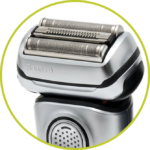
Rav Heinemann paskens that all such shavers work with a scissors action. Higher end models have two foils, with a flat trimmer situated in between them. All such models on the market as of this writing (2026) work with a scissors action.
Halacha: Approved. These are all included within Rav Moshe’s heter.
(2) Rotary Shaver (e.g., Philips Norelco shavers)
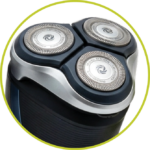
These shavers have three circular rotating heads.
Halacha: Depends. Not all rotary shavers are included within Rav Moshe’s heter.
Whether or not a particular rotary shaver is included within the heter depends on the sharpness of the cutting blades in the rotary head. If the blades are sharp enough that they would be classified as a razor and not as scissors, those blades would not be included in the heter and would need to be slightly dulled before using the shaver. (See guidance below for how to do this.)
If the blades are not that sharp, they would be included in the heter.
(3) OneBlade Shaver
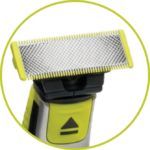
It is hard to determine whether the OneBlade is razor sharp, as one needs to break the shaver head in order to extract the blade.
Rav Heinemann broke open a few of these shavers and felt they did not have uniform sharpness. Due to these contradictory results, Rabbi Heinemann has said that each OneBlade would need to be tested individually to determine whether it is razor sharp. As testing a OneBlade would render it unusable, there is no practical way to do so. Even if we could determine that a OneBlade is razor sharp, that does not necessarily mean that it is forbidden. A razor sharp blade is forbidden only if it cuts close to the skin.
Halacha: Not recommended. Rav Heinemann paskens that it is mutar to use a OneBlade if the blade leaves hair long enough that the stubble can be felt when moving one’s hand over the surface of the skin in the direction of the grain of the hair. It is not sufficient that the stubble can be felt when moving one’s hand against the direction of the grain of the hair.
Tests with the OneBlade regarding whether stubble can be felt when moving one’s hand in the direction of the grain of the hair were inconclusive. As a result of this uncertainty, Rav Heinemann paskens that the OneBlade shaver should not be used.
Testing and Dulling a Rotary Shaver
You can conduct a test to check if the blades of your rotary shaver are razor sharp.
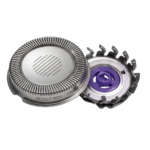
Turn off the shaver and open up the shaver head. Remove the three discs which hold the blades. Each of the three discs has about ten blades arranged around the perimeter, for a total of approximately thirty blades.
Pull out a beard hair and hold it taut. Press the hair against the cutting edge of one of the blades and see if you can cut it without applying pressure.[4] If you can, the blade is razor sharp and needs to be dulled slightly before use.
If the shaver blades are razor sharp, or if you opt to skip the test, you should slightly dull the blades. To do so, scrape the cutting edge of each of the blades against a piece of metal (such as a coin). Scratching each blade just a couple of times is sufficient to dull it.[5] Rav Heinemann feels that there is no need to remove the lift-and-cut mechanism.
[1] Likutei Halachos, Makkos, perek 3.
[2] Kovetz Teshuvos 1:32. See also Ashrei Ha’ish Y.D. pp. 142-143.
[3] See Shevet HaLevi 4:96 and 10:136; Minchas Yitzchok 4:113; Minchas Shlomo 2:97, para. 6; Halichos Shlomo – Tefillah p. 11; Teshuvos Ve’hanhogos 1:459; Chelkas Yaakov O.C. 103:2 and Y.D. 90; Emes le’Yaakov Y.D. 181; Yabiah Omer vol. 9, Y.D. 10.
[4] For a demonstration on how to check electric shavers, see https://vimeo.com/1174893880 and https://vimeo.com/1174900284.
[5] For a demonstration on how to dull an electric shaver, see https://vimeo.com/1174903781.
 STAR-D
 STAR-S