



Fall 2026
Tikkun means to fix or improve. Life in general and Yiddishkeit in particular is in a constant state of tikkun. One trying to improve his or her character traits is actively engaged in tikkun hamidos. Another involved in acts of chesed or working for a worthy cause is involved in tikkun haolam. The owner of a used car may find it in a constate state of tikkun at the mechanic’s shop.
Improving or enhancing a mitzvah is no different. Chanuka is a good example. The baseline kiyum hamitzvah, the fulfillment of the mitzvah of lighting Chanukah licht, is one candle per night per household. Enhancing the mitzvah by each family member lighting his own single candle each night is known as mehadrin. Fulfilling the mitzvah to the ultimate, in which each member of the family lights his own menorah and adds neiros each successive night, is the prevalent custom. The ultimate practice is called mehadrin min hamehadrin.
Our nature is not to aim for the baseline – neither in choosing an esrog nor when purchasing a car. We aspire to grow, to aim for something higher. Who would purchase a baseline esrog? Or a car without air conditioning or power steering? Over time, the old baseline or standard becomes enhanced with new practices. Take the traditional Shabbos seudah of a challah, gefilte fish, cholent and kugel. Today’s Shabbos meal might include an array of dips, teriyaki salmon, charcuterie boards and a sourdough loaf.
Nothing stays basic. The new constantly supplants the old. Even when a healthy snack is advertised as a back-to-basics treat, in the world of brachos it is anything but. Our new world of culinary creativity has been the passion of many a kosher recipe developer, but often when the disparate ingredients build to a culinary crescendo, we may find ourselves encountering a brachos conundrum. A great example of creativity meeting conundrum is the newly popular acai bowl.
A Mini Review of Hilchos Brachos
Let’s start with a short brachos haminim review. The Gemara raises a great question regarding enjoying Hashem’s ample gifts in this world. On the one hand, Dovid Hamelech states that “the earth and all that fills it belongs to G-d” – l’Hashem ha’aretz u’meloah (Tehillim 24:1). But elsewhere, he writes, “the heavens are Hashem’s, but the earth He has given to man” – Hashamayim shamayim l’Hashem v’haaretz nasan livnei Adam (Tehillim 16:115). The Gemara resolves the dilemma: kan l’fnei habracha – kan l’achar habracha (Brachos 35ab). The earth is Hashem’s, but when we make a bracha, we are given permission to partake from and enjoy His bounty.
Brachos come with specific rules with specific directives. Knowing what bracha category a fruit or vegetable falls into is key. A radish is a vegetable and thus the bracha is Borei Pri Ha’adama. A peach is a fruit growing on a tree, thus requiring Borei Pri Ha’eitz. A kiwi grows on a perennial vine, thus the bracha is also Borei Pri Ha’eitz. What about a banana? Is it a fruit or a vegetable? Since a banana stem dies after the banana is picked, it has the status of a vegetable and the bracha is Borei Pri Ha’adama.
A Mini Review of Hilchos Ikar v’Tafel
Life and brachos get more complicated when different foods with different brachos marry.
Halachically, components of a meal or dish that is made up of a combination of foods are viewed subjectively as either ikar (primary) or tafel (secondary). If they are of equal importance, they are shoveh b’shoveh. The Beis Yosef (Hilchos Brachos O.C. 204:7 and 212:1) outlines the basic priority of brachos when the item is a combination of multiple ingredients.
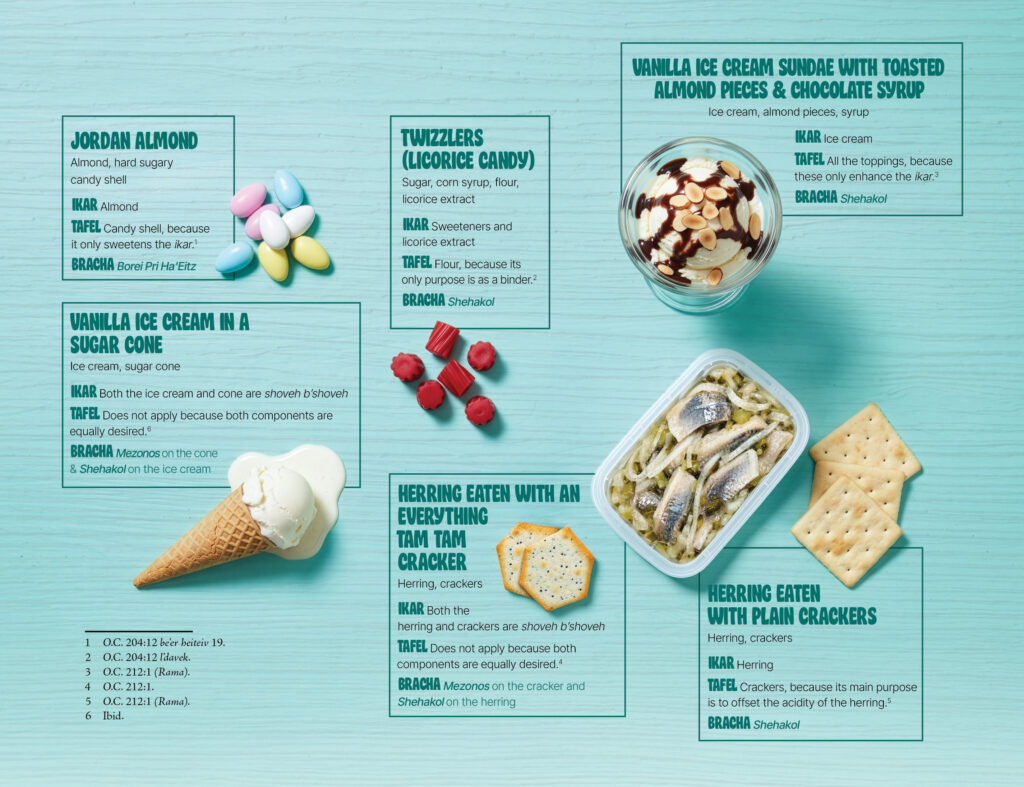
Common examples of ikar and tafel situations and the brachos that apply are shown in Fig. 1 below.
Whenever there is an ikar and tafel situation, in essence the bracha on the ikar fulfills the bracha of the tafel. But what about a situation in which the ikar is actually rendered a tafel? Enter the acai bowl.
The Acai Bowl Bracha Conundrum
What is acai and why has acai gained such popularity? Acai is a small dark purple fruit. Its origin is the Amazon rainforest. Acai is known as a “super fruit” because it is packed with antioxidants, fiber and healthy fats. The acai palm tree is a perennial, so the bracha on an acai berry is Borei Pri Ha’eitz.
However, commercial acai is sold only as a puree and cannot be eaten plain. It requires the assist of other fruits to impart sweetness. In concocting an acai bowl, various fruits are blended with the acai puree and frozen to make a base, which may then be topped with bananas and an assortment of berries. Once additional garnishes – such as coconut flakes and granola – are scattered on top, and the entire concoction is drizzled with honey, Nutella or chocolate syrup, the acai bowl becomes a bracha labyrinth. (See the Acai Bowl recipe in the sidebar below.)
If we break down the acai bowl into its halachic components, we arrive at some fascinating bracha insights.
Obviously, the main component of the acai bowl is its purple base, which normally would constitute the ikar. However, since other fruits and natural components are needed to flavor the acai, plus the fact that the entire base is completely pureed, Rav Moshe Heinemann shlit”a paskens that the bracha on the base is Shehakol. He considers the acai base as halachically comparable to chocolate, which requires the assistance of sugar to achieve its confectionary excellence. Other ingredients are usually added to give chocolate its compelling flavor. Therefore, the bracha of chocolate is downgraded from Borei Pri Ha’eitz to Shehakol. The same holds true for the acai bowl.
Unlike chocolate, however, the acai bowl needs the addition of whole fruits and granola toppings to make it palatable. In this case, the whole fruit toppings (which are part of the tafel) augment the pureed fruit in the base (which technically make up part of the ikar). Thus, the Borei Pri Ha’eitz of blueberries and the Borei Pri Ha’adama of sliced banana and strawberries in the toppings motzee (fulfill) the brachos requirements of the acai base. Any granola, coconut flakes, drizzled honey or Nutella constitute minor enhancements, and thus do not require additional brachos, as these are true tafel components.
An acai bowl is a fascinating illustration of how a tafel (in our example, whole fruits) can fulfill the bracha requirements of an ikar (i.e., pureed fruits) and how, in turn, the ikar fulfills the requirements of the remaining toppings (i.e., the coconut, granola and honey).Who can top that!
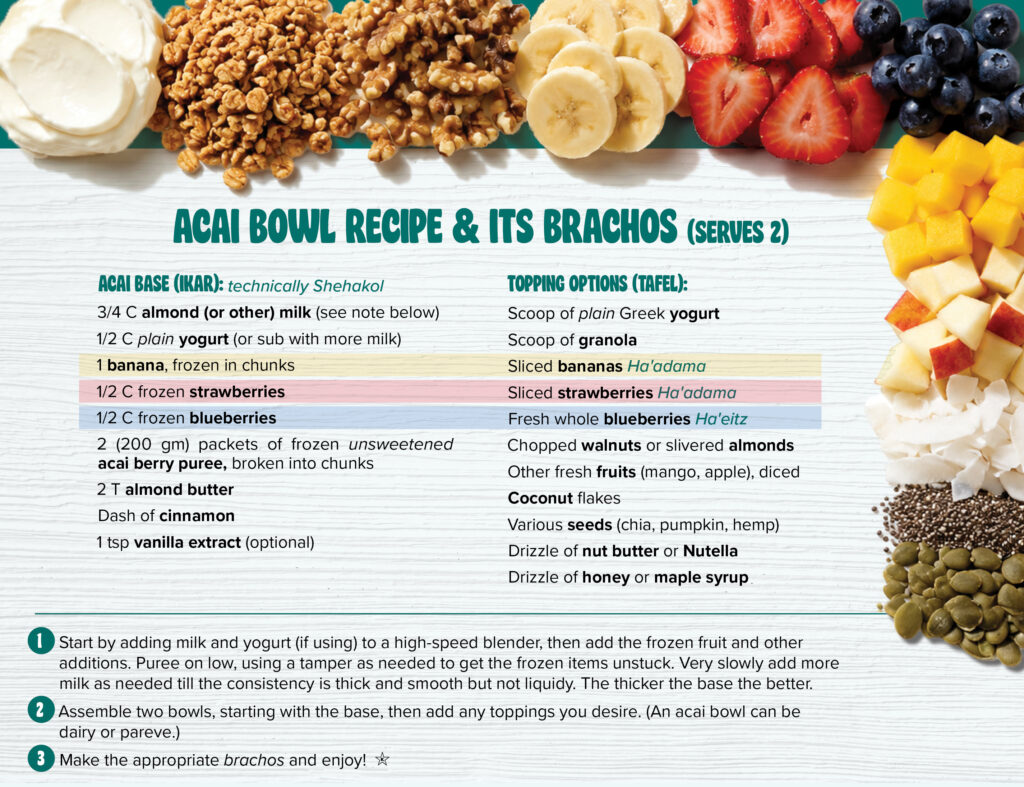
SIDEBAR: Acai Bowl Recipe & Its Brachos
 STAR-D
 STAR-S