



Summer 2026
When the Torah commands: ubasar basadeh treifah lo socheilu” (Shmos 22:30) – “you may not eat treif meat” – it is not making a general statement about non-kosher food, which is the common understanding of the word treif. Here, treif refers specifically to an animal whose flesh was torn or ripped.
Technically speaking, if a kosher species of animal or fowl is attacked by a predator, the meat of the victim may be deemed treif. The meat of a kosher animal slaughtered improperly is actually called a neveila. The flesh of a non-kosher animal species, on the other hand, is the meat of a temei’ah. Still, the term treif has found its way nowadays to be generally synonymous with non-kosher. That is how we will be using the term from here on.
The Mitzvah of Shechita
The halacha requires that all animals and fowl used for kosher consumption be from a kosher species and slaughtered by a shochet. Once shechted, the freshly slaughtered animal or fowl must undergo a series of inspections (bedikos) to verify its health and wholesomeness. If the animal was found to have suffered an internal defect (such as a rip, puncture, or broken bone) or if the animal appeared to be suffering from an illness or defect that was determined to be terminal had the animal lived, the animal would more than likely be deemed treif.
While some treif characteristics can be determined through external examination, an animal or fowl cannot be kosher approved without an internal examination (bedikas p’nim). This examination is needed to determines that the internal organs are free from any holes, punctures, defects, or disease that would disqualify the animal and render it non-kosher.
During the internal examination, it is common to find adhesions (sirchos) on the animal’s lungs. An adhesion is an abnormal condition in which tissues are united by fibrous matter. These adhesions may be indicative of a puncture in the lung wall beneath the adhesion. A puncture of the lung will disqualify an animal and render it treif.
Occasionally, the adhesion is not hiding a puncture. This can be determined through skillful removal of the adhesion. Once removed, the smooth lung can be tested by filling it with air and submerging it underwater. If air bubbles appear in the water, it is an indication that the lung has been punctured and the animal is treif. If the submerged lung is airtight, the animal is kosher.
The Differences Between Kosher, Glatt and Beit Yosef Glatt
It is important to understand the different standards of kosher meat. Just as the meat industry distinguishes the quality of its meat through its grading (i.e., Prime or Choice), so, too, the world of kashrus uses different labeling to indicate the final kosher status of the meat. In the USA, kosher meat displays one of the following labels:
►Beit Yosef Glatt – The lung was found to be free of adhesions.
►Glatt Kosher – Any adhesions found were exceptionally thin (i.e., comparable to a strand of sewing thread); the adhesion peeled off easily, leaving no hole in the lung wall; and the adhesion-free lung passed the air/water test.
►Regular Kosher – The lung had adhesions that were thicker or wider in nature, but upon removal they did not leave any hole in the lung wall and the lung passed the air/water test. [1]
Generally speaking, it has been the custom of Ashkenazi Jews of European descent to eat Beit Yosef Glatt, Glattand non-Glattmeats, and to accept all three as kosher. On the other hand, Beit Yosef Glattmeat certified only by Sephardi hechsheirim may rely on leniencies of the Beis Yosef that are not acceptable to Ashkenazim. STAR-K Beit Yosef Glatt certified meats are acceptable to both Sephardim and Ashkenazim.
The GlattKosher criteria apply to the meat of gasos – adult cattle (i.e., beef). This list includes the meat of steers, heifers, bulls, cows and buffaloes. Therefore, a butcher could legitimately advertise “GlattKosher” rib steaks and “Kosher” rib steaks. Deer, sheep, goats, lambs, calves, and all fowl (chickens, turkeys and ducks), however, are judged by a different set of halachic standards – they cannot have any adhesions whatsoever. Once they have passed the shochet’s inspection, they always meet the higher standard and can be certified as Beit Yosef Glatt.
The Labeling of Glatt Kosher Chickens
Sometimes suppliers or proprietors will advertise “GlattKosher” chickens to promote their product. This implies that the Glatt Kosher chicken is of higher kosher quality than “Regular Kosher” chickens, and that a chicken could be kosher without being Glatt. This is a myth, since every chicken in the United States must be“Beit Yosef Glatt”to be considered kosher. The fact is that in the U.S. there isn’t a concern of Virulent Newcastle Disease (VND), like there is in Israel, which obviates the need to check the lungs of domestic chickens.
In Israel, however, the lungs of the chickens are checked due to the prevalence of the VND virus. In fact, there are two types of chicken that are sold in Israel: Mehadrin and non-Mehadrin. Mehadrin chickens, whose lungs are checked, are considered Beit Yosef Glatt,while the non-Mehadrin chickens are considered “Regular Kosher.”
Treiboring/Nikkur
Regardless if the meat is advertised as Beit Yosef Glatt or Glatt Kosher, the kosher meat process does not end with the examination of the lungs. There are many more steps that must be taken before the meat reaches the kitchen.
Certain fats found in kosher domestic animals are forbidden by Torah law. These forbidden fats are categorically termed cheilev and are found in all varieties of cattle, sheep and lambs. Fortunately, most of the forbidden cheilev is found in the hindquarters of these animals. In the United States and most European countries, the hindquarters are not processed for kosher use.
According to Jewish custom, cheilev removal includes not only actual cheilev but also various parts of the animal that touch the cheilev, fats that may be confused with cheilev, and those parts whose nutrition comes from cheilev. Additionally, the forequarters of these kosher species contain various blood arteries, blood veins, glands, membranes and tendons that must be skillfully removed by a trained expert before meat can be kashered (i.e., soaked and salted). This is because soaking and salting alone will not remove the blood.
The removal process is referred to as treiboring in Yiddish and nikkur in Hebrew. The one who performs this process is known as a menaker. Treiboring permits the free flow of blood from the meat during soaking and salting. The art of treiboring is not new to the Jewish scene. This tradition has been practiced and handed down from generation to generation. Understandably, many communities have their own treiboring traditions with their individual differences and nuances. In Baltimore, the portions of the forequarter are treibored as shown in Fig. 1 as well as the chart below:
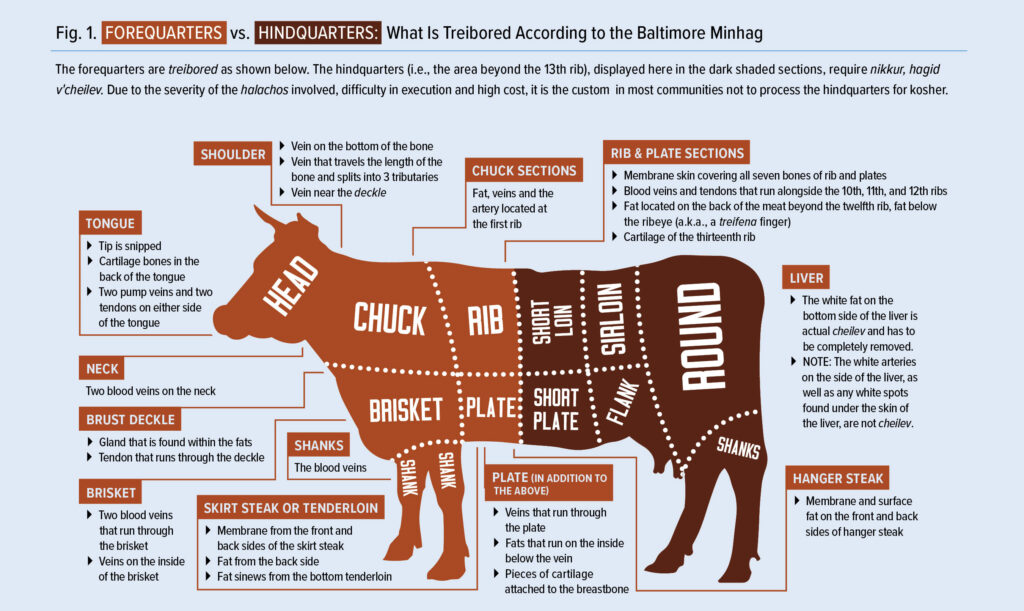
| Portion | What Is Treibored According to the Baltimore Minhag |
|---|---|
| Brisket | Two blood veins that run through the brisketVeins on the inside of the brisket |
| Brust Deckle | Gland that is found within the fatsTendon that runs through the deckle |
| Chuck Sections | Fat, veins and the artery located at the first rib |
| Hanger Steak | Membrane and surface fat on the front and back sides of the hanger steak |
| Liver | The white fat on the bottom side of the liver is actual cheilev and has to be completely removed. NOTE: The white arteries on the side of the liver, as well as any white spots found under the skin of the liver, are not cheilev. |
| Neck | Two blood veins on the neck |
| Plate (in addition to Plate info below) | Veins that run through the plateFats that run on the inside below the veinPieces of cartilage attached to the breastbone |
| Rib & Plate Sections | Membrane skin covering all seven bones of rib and platesBlood veins and tendons that run alongside the 10th, 11th, and 12th ribsFat located on the back of the meat beyond the 12th rib, fat below the ribeye (a.k.a., a treifena finger)Cartilage of the 13th rib |
| Shanks | The blood veins |
| Shoulder | Vein on the bottom of the boneVein that travels the length of the bone and splits into 3 tributariesVein near the deckle |
| Skirt Steak or Tenderloin | Membrane from the front and back sides of the skirt steakFat from the back sideFat sinews from the bottom tenderloin |
| Tongue | Tip is snipped Cartilage bones in the back of the tongue Two pump veins and two tendons on either side of the tongue |
Melicha
All meat and poultry must undergo a soaking, salting and rinsing procedure (hadacha u’melicha v’hadacha) before the meat can be further processed. This procedure must be initiated within 72 hours of the slaughter of the animal or fowl.
Some authorities permit the washing down of the meat within the 72-hour period to extend the time for kosherization for another 72 hours. Most Glatt Kosher facilities do not permit this practice, unless the meat was actually soaked in water for 1/2 hour within the 72-hour period. This extends the kashering time for the meat for an additional 711/2 hours. Unfortunately, the wash-down system has been severely abused and compromised in the United States. There are places that have been known to use a spray mist or damp rag instead of water to “wash down the meat.”
The soaking and salting process must follow these steps:
- The meat is soaked for 1/2 hour in cool (not freezing) water (≥ 50°F).
- The exterior of the soaked meat is cleaned of any visible blood, then salted on all sides with kasheringsalt. In the case of poultry, the inside cavity must also be salted. The salt should be neither too fine nor too coarse.
- The meat or poultry is placed on a board or rack which allows the outflow of blood from the meat.
- The salt is left on the meat or poultry for one hour, then rinsed off three times to remove all the salt and blood.
Choosing Your Butcher: Integrity is Key
The process of treiboring and melicha by a reliable butcher, kosher provision house, or home cook must be done before the meat can be considered fit for consumption. It goes without saying that if the meat was procured from a slaughterhouse of questionable integrity, even the most stringent treiboring and kashering would render the meat problematic kashrus-wise. Integrity and reliability, not Glatt or Beit Yosef Glatt labels, should be the true guiding principles for the kosher consumer. Therefore, it is always advisable to purchase meat that has been endorsed by a respectable rabbinic authority or kashrus organization. It is certainly advisable to purchase meat and poultry from a butcher who is scrupulous in his attention to the halachos involved and who displays genuine integrity and commitment to Torah and mitzvos.
[1] This topic is further expanded in “Produccion de Carne Kasher: Shechita Flies South” by Rabbi Zvi Holland (Kashrus Kurrents, Spring 2024).
 STAR-D
 STAR-S