



Winter 2026
The incredible edible egg. Eggs are, indeed, incredible. They can be hard boiled, soft boiled, fried or scrambled and are an essential ingredient in baking. Eggs give challah a shining glow. When my mother a”h was not feeling well – and when all else failed – she drank a gogel mogel, two raw eggs mixed with honey … and it did the trick.
Then there’s the reproductive aspect of eggs: when they hatch into chicks who mature into hens, we are afforded sumptuous varieties of poultry delicacies that are staples of our Shabbos tables. These are all excellent outcomes of Hashem’s incredible creation.
But are all eggs equal? More importantly, are all eggs kosher? As we shall soon explain, the incredible edible egg is, in some cases, incredibly inedible from a kashrus standpoint.
The Kashrus of Eggs
The Shulchan Aruch (Y.D. 86:1) teaches that the simanim for a kosher egg are that its shape is circular (kad) on one end and pointy (chad) on the other. Additionally, the yellow yolk, the chelmon, should be surrounded by the white albumen, the chelbon.
It then poses a question: If an egg meets the kosher criteria, can it be purchased without discretion? The answer is, it depends.
Following the conclusion of the Shulchan Aruch (Y.D. 86:2), which provides us with the simanim of a kosher egg, we can purchase all eggs – whether white or brown – from our local supermarkets with complete confidence. The Rema (Y.D. 82:3), however, clearly states that in order to purchase non-commercial eggs (e.g., those we might find at a farmer’s market or a gourmet food store), we must have information about the layers’ halachic pedigree. A chicken requires a mesorah to be accepted as a kosher bird.
For instance, the proprietor of your local market farmstand tells you that this perfectly kosher-looking, kad v’chad egg is from the Resplendent Quetzal,[1] and you have no idea if the Resplendent Quetzal is even a kosher bird. In such a case, you may not eat the egg.
Chickens in the Backyard
Backyard chickens are most definitely on the rise. They currently place fourth in domestic pet rankings, right behind dogs, cats and fish. It is estimated that 13% of American households are now raising backyard chickens.
Their popularity can partly be attributed to the exorbitant rise in the cost of eggs resulting from the rampant spread of bird flu. This avian epidemic has meant the culling of millions of commercial layers throughout the U.S. Many households have turned to raising their own layers both to offset these costs and to enjoy the pleasure of caring for them as pets.
But in most cases, in today’s non-agrarian society, ask a 3-year-old where milk or eggs come from and he will answer without hesitation: milk comes from the jug inside the refrigerator, and eggs from the carton in the refrigerator door. Ask an adult where eggs come from and he will reply: from a chicken. But few of us have an inkling as to the journey of a chicken layer from hatchery to egg house.
The lifecycle of a chicken is pretty straightforward. Chicks are hatched and raised in a hatchery through their next stage of growth. This pre-egg-laying chicken is known as a pullet. Once a pullet begins to lay eggs, it is known as a hen.A pullet can begin laying eggs when it reaches 16-18 weeks (approximately four months old). Full maturity is reached by week 20. A hen continues to lay eggs commercially until week 80 (not quite two years).
But the question remains: Do all varieties of backyard chickens meet the halachic mesorah criteria? Surprisingly not. Due to crossbreeding, unusual appearance, extra toes, unusual plumage and odd colored eggs, not all chickens are created “mesoratically” equal. Of the ten most popular breeds of backyard chickens,[2] only four make the halachic cut (see Fig.1).
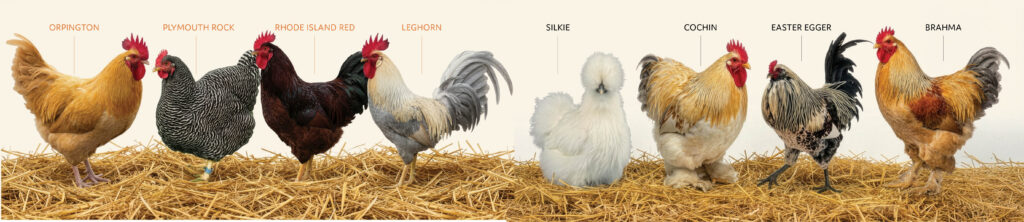
| Ranking | Variety | Highlights | Acceptable/Not |
| 1 | Orpington | 175-200 eggs annually | YES |
| 2 | Silkie | Blue earlobes, 5 toes on each foot | No |
| 3 | Plymouth Rock | Large brown eggs | YES |
| 4 | Easter Egger | A hybrid, not a true breed | No |
| 5 | Australorp | Large brown eggs | No |
| 6 | Brahma | Light brown eggs | No |
| 7 | Cochin | Large brown eggs | No |
| 8 | Rhode Island Red | Large brown eggs | YES |
| 9 | Ameraucana | Blue eggs | No |
| 10 | Leghorn | Large white eggs | YES |
Fig. 1: Top Ten Most Popular Varieties of Backyard Chickens
Commercial Egg Production
The commercial egg business is far more complex than home egg laying. Commercial egg laying is a complex, multi-tiered business known in the industry as a “layer farm sequence,” from hatching to chicken coop to egg laying. I guess in baseball terms, you have to go from the farm clubs to the major leagues. No matter the breed, all layers have to go through the basics. As noted above, the good news is that all commercial eggs come from kosher breeds.
Of course, choosing the right chicken breed that will produce the best egg in a particular region is left to the discretion of the skilled breeder (see Sidebar). Much of the skill and success of commercial egg production rests on an optimum environment, climate and diet. In short, a happy chicken will be the best egg producer.
______________________________________
Sidebar: STAR-K Interview with Kreider Farms
Due to STAR-K’s longstanding close relationship with Kreider Farms and its chief operating officer Tom Beachler, and his son, director of egg operations Ben Beachler, we are fortunate to be able to glean some insights into a fascinating industry. Kreider is the largest egg producer in Pennsylvania and in the “top ten” of egg producers in all of the U.S.
What is the primary breed Kreider uses for laying white eggs?
We exclusively use four Leghorn varieties – Hyline, DeKalb, Lohmann and H&N – with the same extensive breeding background, all of which produce white eggs.
How does Kreider maintain the purity of its Leghorns?
The birds used at commercial level to produce table eggs are a cross of 4 pure lines – A, B, C and D. The purelines are always reproduced within the same line, so AxA, BxB and so forth. A crossline bird performs better than the average of two parental purelines. The four-way cross – AxB + CxD – is necessary to achieve hybrid vigor, or heterosis. In heterosis, the offspring of genetically distinct parents exhibit superior traits, such as increased size, fertility and yield.
At what age do the hens arrive at the Kreider Egg Farm?
They arrive at the hatchery when they are a few days old and are sent to a pullet house where they are raised until they reach 18 weeks. At that point, they are mature enough to lay eggs.
How long do the hens produce eggs?
Typically, 80 weeks. However, with a careful diet and a healthy environment, we can extend their egg-laying capability to 100 weeks.
We know Kreider puts great effort into keeping their cows happy. How do you keep chickens happy?
Chickens are happiest in a dim light, which they find the most soothing. Our chicken coops, which can house upwards of 100,000 birds, are designed to receive 16 hours of controlled daylight per day, after which the lights are dimmed. While light triggers egg laying, if the lights are too bright, the chickens become aggressive and start pecking each other.
What is the difference between cage-free and free-range?
We have both cage-free and free-range chickens and there are important distinctions between the two. Cage-free birds are free to roam but remain within the henhouse enclosure. They have nests on perches which is where they go when they are ready to lay eggs. Free-range chickens wander outside, but that makes them more susceptible to avian flu, which is airborne. Obviously, we find it is more advantageous to house our chickens indoors to prevent them from being exposed to this deadly virus.
Some Kreider chickens are white and some are brown. What are their differences?
Our white chickens are Leghorns and the brown ones are Rhode Island Reds. Their earlobes indicate the color of their eggs – the brown ones lay brown eggs and the white ones lay white eggs. We need to keep them separated for their own good; when they are together, they start exhibiting aggressive behaviors which often lead to serious injury, or worse.
Do you ever experiment with different breeds of chickens, or do you stick to the basic rule of “if it ain’t broke, don’t fix it”?
The gene pool is a closed nucleus to avoid the introduction of any foreign genetic material. Genetic variability is maintained through a permanent mating regime to avoid inbreeding matings. We are passionate about maintaining the genetic purity of each line.
[1] A rare bird species.
[2] https://www.backyardchickens.com/articles/top-10-favorite-backyard-chicken-breeds.76182/
 STAR-D
 STAR-S